All content on this site is intended for healthcare professionals only. By acknowledging this message and accessing the information on this website you are confirming that you are a healthcare professional. If you are a patient or carer, please visit Know ALL.
The ALL Hub website uses a third-party service provided by Google that dynamically translates web content. Translations are machine generated, so may not be an exact or complete translation, and the ALL Hub cannot guarantee the accuracy of translated content. The ALL Hub and its employees will not be liable for any direct, indirect, or consequential damages (even if foreseeable) resulting from use of the Google Translate feature. For further support with Google Translate, visit Google Translate Help.


The ALL Hub is an independent medical education platform, sponsored by Amgen and Autolus. Funders are allowed no direct influence on our content. The levels of sponsorship listed are reflective of the amount of funding given. View funders.
Now you can support HCPs in making informed decisions for their patients
Your contribution helps us continuously deliver expertly curated content to HCPs worldwide. You will also have the opportunity to make a content suggestion for consideration and receive updates on the impact contributions are making to our content.
Find out more
Create an account to access:
Bookmark & personalize site content
Receive alerts for new content in your areas of interest
View ALL content recommended for you
 André Baruchel
Do you know... Patients with B-ALL and what characteristic typically achieve good outcomes with blinatumomab treatment?
The ALL Hub was pleased to speak with André Baruchel, Robert-Debré University Hospital, Paris, FR. We asked, How should patients with acute lymphoblastic leukemia (ALL) be selected for blinatumomab treatment?
In this interview, Baruchel discusses how patients with B-cell ALL (B-ALL) should be selected for blinatumomab treatment. He highlights several considerations, including tumor burden, measurable residual disease (MRD) response, CD19 expression, and patient fitness. He also explains the role of blinatumomab as a chemotherapy-sparing treatment and as a bridge to allogeneic hematopoietic stem cell transplantation (allo-HSCT).
How should patients with ALL be selected for blinatumomab treatment?
How should patients with ALL be selected for blinatumomab treatment?
Key points
- Blinatumomab is a bispecific CD19-directed CD3 T-cell engager currently approved by:
- The U.S. Food and Drug Administration for adult and pediatric patients with CD19+ Philadelphia chromosome-negative B-ALL during consolidation, CD-19+ B-ALL in first or second complete remission with MRD ≥0.1%, and relapsed/refractory CD19+ B-ALL.1
- The European Commission for adults with CD19+ Philadelphia chromosome-negative relapsed/refractory B-ALL or CD19+ Philadelphia chromosome-positive B-ALL in first or second complete remission with MRD ≥0.1%, and for pediatric patients with CD19+ Philadelphia chromosome-positive B-ALL which is refractory or in relapse after receiving ≥2 prior therapies or in relapse after receiving prior allo-HSCT.2
- Expert recommendations support the inclusion of blinatumomab in first-line treatment strategies for the majority of patients with B-ALL, either in combination with or as a replacement for conventional chemotherapy.3
- A high tumor burden is associated with an increased risk of cytokine release syndrome (CRS) and neurologic toxicity; therefore, patients with a lower tumor burden, or those who can undergo tumor-lowering strategies, are likely to have improved outcomes with blinatumomab.4
- Favorable responses to blinatumomab are particularly noted in patients persistent or recurrent MRD after chemotherapy.1,5
- Blinatumomab may also have a role in MRD-negative complete remission, with the ECOG-ACRIN E1910 study (NCT02003222) demonstrating higher 3-year overall survival with blinatumomab plus chemotherapy vs chemotherapy alone (85% vs 68%; hazard ratio, 0.41; 95% confidence interval, 0.23–0.73; p = 0.003).6
- Blinatumomab requires CD19+ disease; prior CD19-directed therapy can lead to reduced (CD19-dim) or absent CD19 expression, which is associated with poorer outcomes with subsequent CD19-directed therapies.7
- Blinatumomab is less myelosuppressive than conventional chemotherapy and therefore provides a chemotherapy-sparing option for patients who have experienced significant chemotherapy-related toxicity.8
- As a medical history of neurologic signs and symptoms is associated with an increased risk of neurological events with blinatumomab, treatment risk vs benefit should be carefully considered in these patients.1,2 Little is currently known about the use of blinatumomab in patients with active uncontrolled infection; all patients who receive blinatumomab should be monitored for signs and symptoms of infection.2
- Blinatumomab can also be used to bridge patients to allo-HSCT or to provide disease control in relapsed/refractory ALL. 1,3
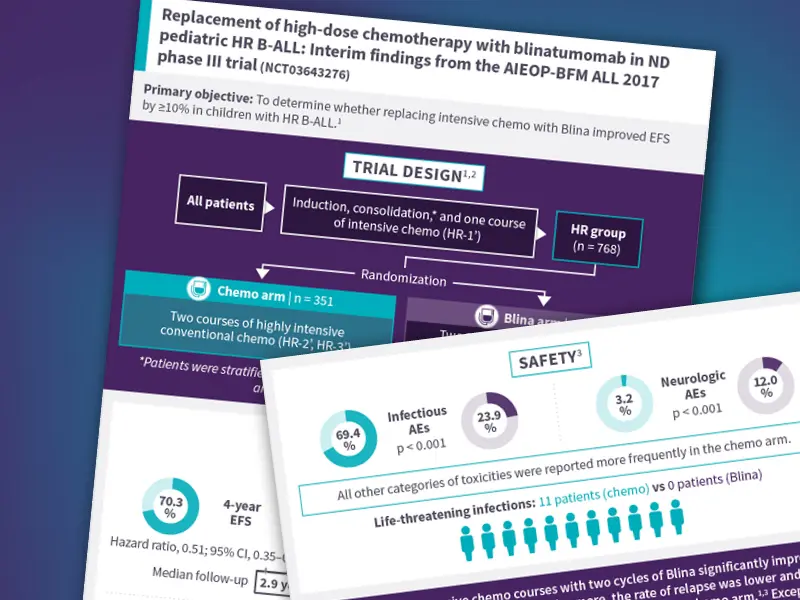
- In pediatric B-ALL, emerging evidence is helping to further define the role of blinatumomab in first-line treatment, including its potential to replace or reduce components of chemotherapy.9,10
References
Please indicate your level of agreement with the following statements:
The content was clear and easy to understand
The content addressed the learning objectives
The content was relevant to my practice
I will change my clinical practice as a result of this content
This content is accurate as of the date of publication and is not updated retrospectively. Please refer to the latest available evidence, guidelines, and relevant regulatory information when making clinical decisions.
More from this series:

.webp)